The Green House
In 2008, the first images of London’s 244-254 Cambridge Heath Road were uploaded to Google Maps.
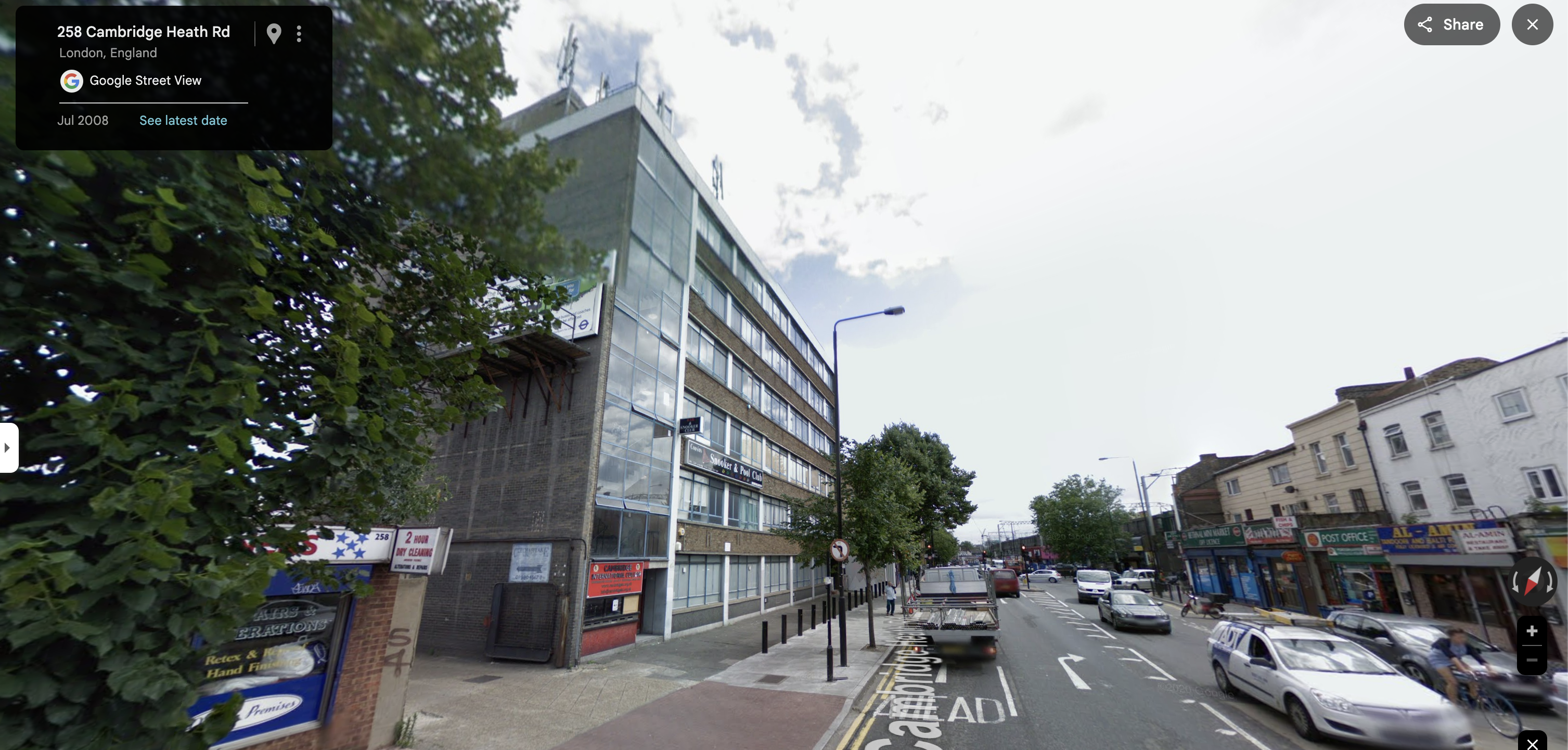
The building’s exterior wasn’t particularly friendly - most windows were shrouded in permanently closed drapes and a few were boarded over. The only advertisements of occupying businesses were for Cambridge International College and Cousin’s Snooker Club. In fact, this 1960s concrete-frame office building had been sitting derelict for several years.
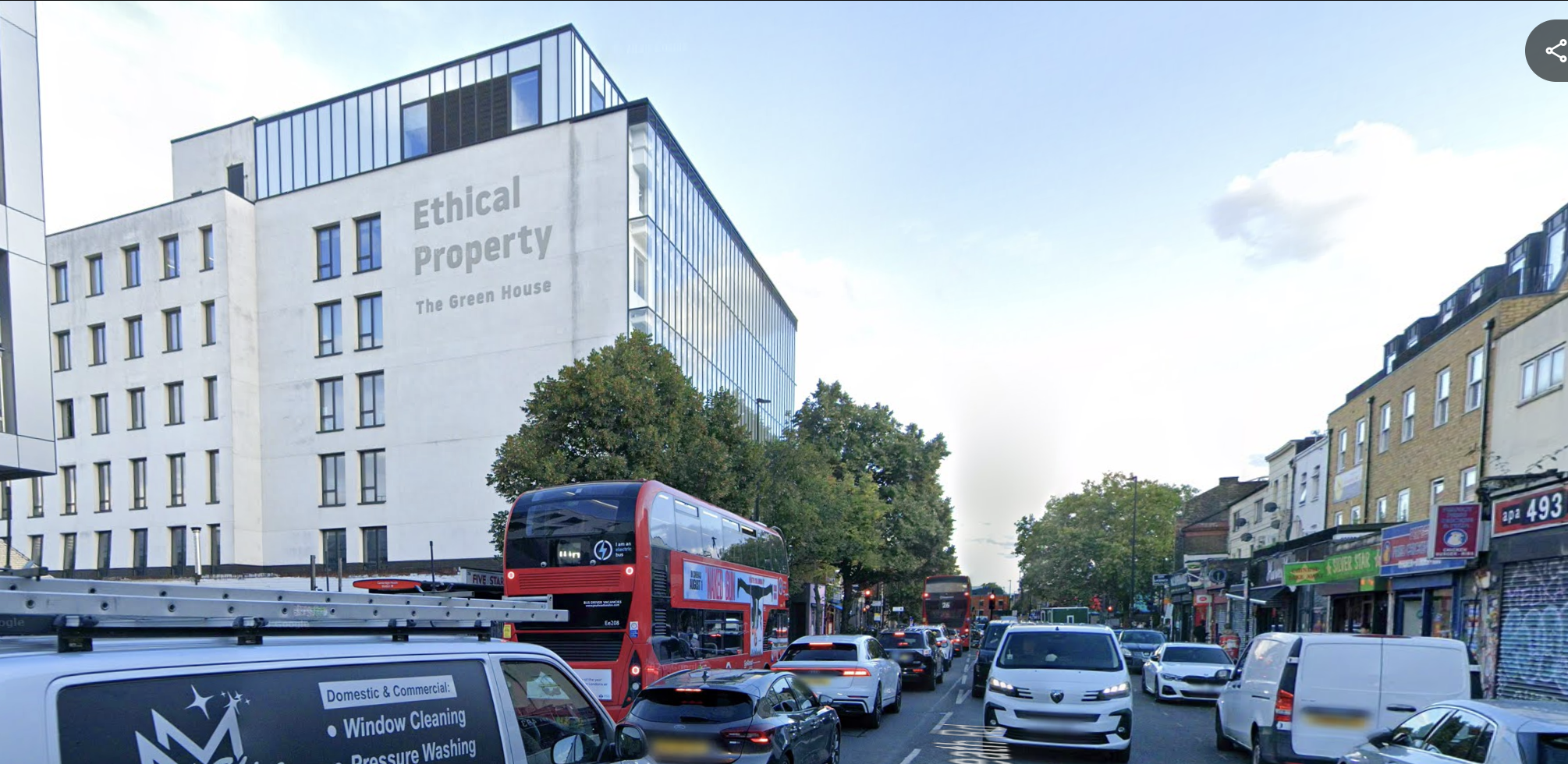
This changed in 2017, almost 60 years after the building’s original construction. Ethical Property Company acquired the land with a plan to provide 7000 m^2 of rental office space to small sustainability-focused businesses and non-profits. These new owners could have demolished the building and replaced it with something new like a concrete tower or a mass timber mid-rise. However, they realized that recycling and refurbishing the existing concrete structure was the lowest-carbon option, and created a renovation plan of action to facilitate this expansion.
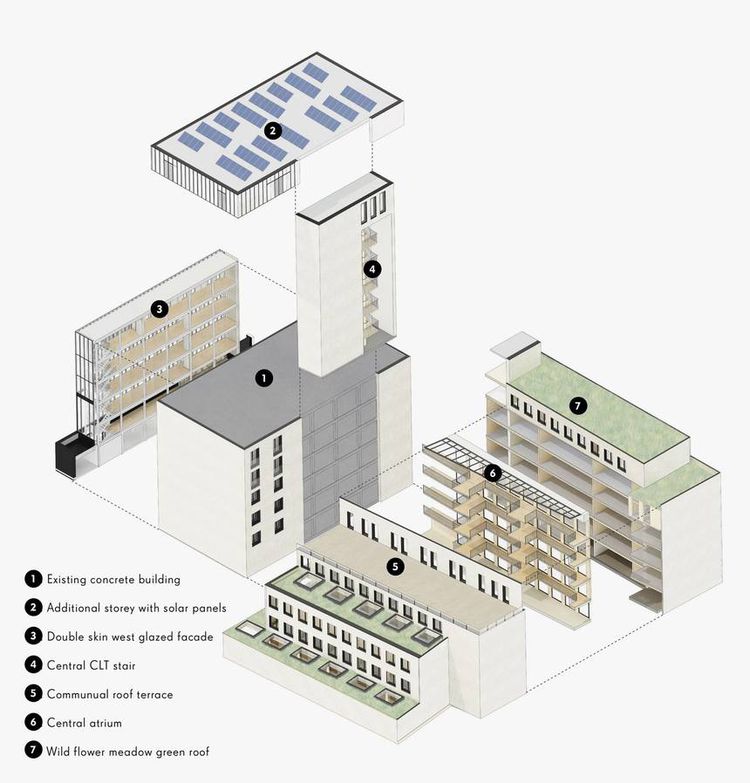
The existing concrete building, which took up a little less than half the total lot, had its interior refurbished, a floor added, and a double-skin facade tacked on to the front (increasing energy efficiency through a naturally-ventilated trombe wall). The extension moved the building’s setback forward to align with neighbouring buildings, replacing what had previously been additional sidewalk space.
They also added 5-storey CLT + GLT office space horizontal extension to fill the rest of the lot. This new extension was connected to the core of the original concrete offices with an added CLT staircase.
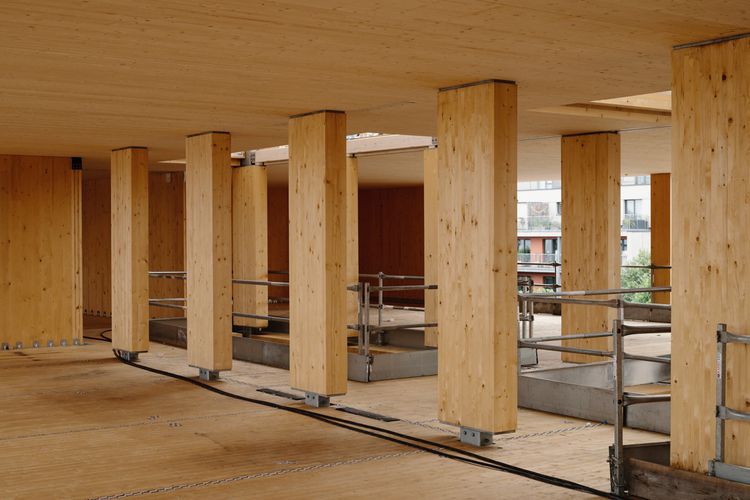
400 tons of CO2 were saved by keeping the original concrete frame (as opposed to building new with concrete), the equivalent of about 300 round-trip flights from Vancouver to London. There was additional carbon saved and stored in the mass timber extension.
Now, Ethical Property’s “The Green House” hosts several major social change organizations, and has several thousand square meters of modern coworking spaces for similar impact organizations.
Vertical Extensions: The Concept
The Green House’s redevelopment is part of a larger European trend that’s just now making its way to North America, as cities densify and implement stricter embodied carbon emissions standards. Aufstockung - the German term for adding one or more floors to an existing structure (a vertical extension) is a surprisingly common type of development in Switzerland, Germany, Belgium and beyond, and has been for generations.
While 244-254 Cambridge Heath only added one floor above the structure’s six, it embodies the principles of aufstockung by creating economic value and reducing carbon emissions through the renovation and extension of an existing structure.
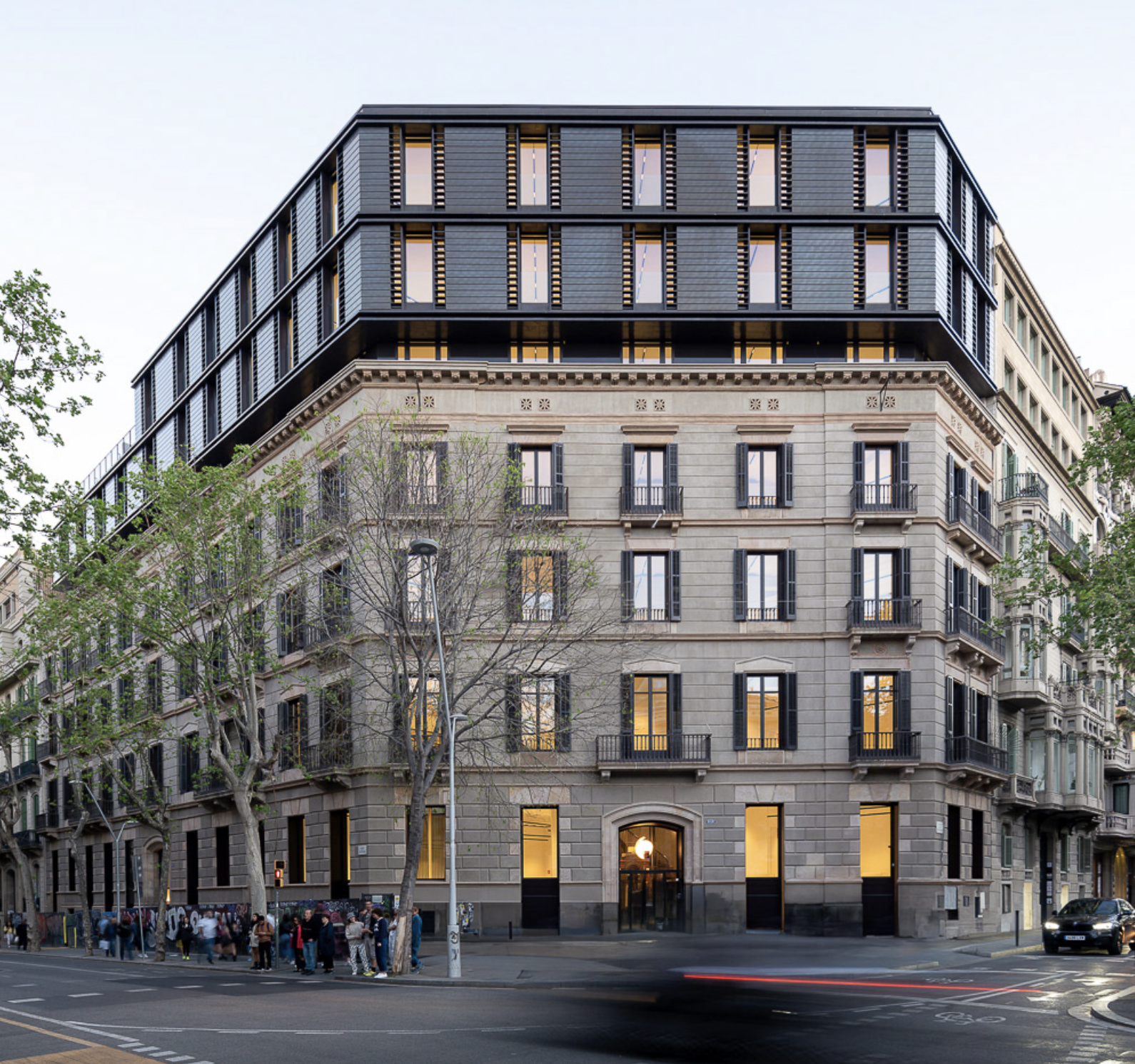 The Nubiola Building, a two-storey vertical extension in Barcelona’s Eixample district
Optoppen - the Dutch word for vertical extensions - is a company named after this concept. On opening their website, you’ll see a slick tool with interactive sliders letting users create a base building, which, through the power of optoppen, is magically transformed into up to five stories of additional space. However, as Lloyd Alter - a professor of sustainable design at TMU - notes on his substack:
Quote
Having done an Austockung/ Optoppen as my last project as an architect, I found the tool a bit simplistic. To add a floor to the top of a five-storey building, we had to rezone the site, add a steel frame inside to brace the building for wind and earthquake loads, and bring all the exiting and fire protection up to code. It was very complicated and difficult, even traumatic, and it made me not want to be an architect anymore. The entire Optoppen website makes it all sound too easy.
Despite real-life complexities, Optoppen’s website notes that, according to research by Skyroom, there could be capacity to build 630,000 new homes on top of London’s municipal buildings. Knight Frank suggests there is scope to build 41,000 rooftop homes in central London alone; and the architecture firm HTA Design has identified capacity for precisely 179,126 new homes.
Considering there isn’t a one-size-fits-all approach to vertically extending old buildings, let’s dive deep on the challenges of this type of redevelopment, where the economics pencil, and whether it’s actually less carbon intensive than new buildings.
Technical Challenges
Why would developers take on the risk of upgrading the structure of a building that could be 100+ years old when the creation of a new building is something that happens hundreds of times per day around the world?
Gillott’s 2022 thesis on the Potential for the vertical extension of existing buildings notes several of the perceived technical challenges of vertical extensions:
- the assessment of existing buildings is seen as specialist discipline within structural engineering
- there is limited availability of original design information (drawings, material test results, etc.)
- client requirements can clash with an existing building’s layout
There’s also laws requiring the renovated building be brought up to present-day codes. This compliance is ideally something that adds value to the entire building, but could add unforeseen costs (showcasing the importance of proactive design for aufstockengen).
For example, the 1970s saw the UK introduce requirements to consider “disproportionate collapse” following the failure of the Ronan Point tower. Approximately half of present-day flats were built without those robustness codes in mind. Additionally, extending a post-1970s block may trigger additional reinforcement due to the increase in “consequence”. For example, moving from four to five storeys will result in a change in Consequence Class from 2a to 2b, adding the (costly) requirement for vertical ties in addition to horizontal ties.
However, some of these difficulties are perceived as more complicated than they are in reality. Interviewees in the thesis noted that engineers in school don’t usually learn how to assess the structural integrity of existing buildings. In fact, there are few urban development companies that are dedicated to the aufstockung paradigm, and consultants that do undertake specialized renovation projects aren’t typically paid a premium. The thesis notes it could be useful to have engineers skilled in understanding whether an extension would be viable or not, and if it was, they’d have the expertise needed to connect the entire redevelopment process, from design to supply chain.
Pushing the Limits: South Bank Tower
The 11 storeys added to London’s South Bank Tower in 2018 represent one of the most technically ambitious vertical extensions of a modern high-rise. At an already tall 31 storeys, this vertical extension added 155m to the total height through an extended concrete core wrapped in a structural steel frame.
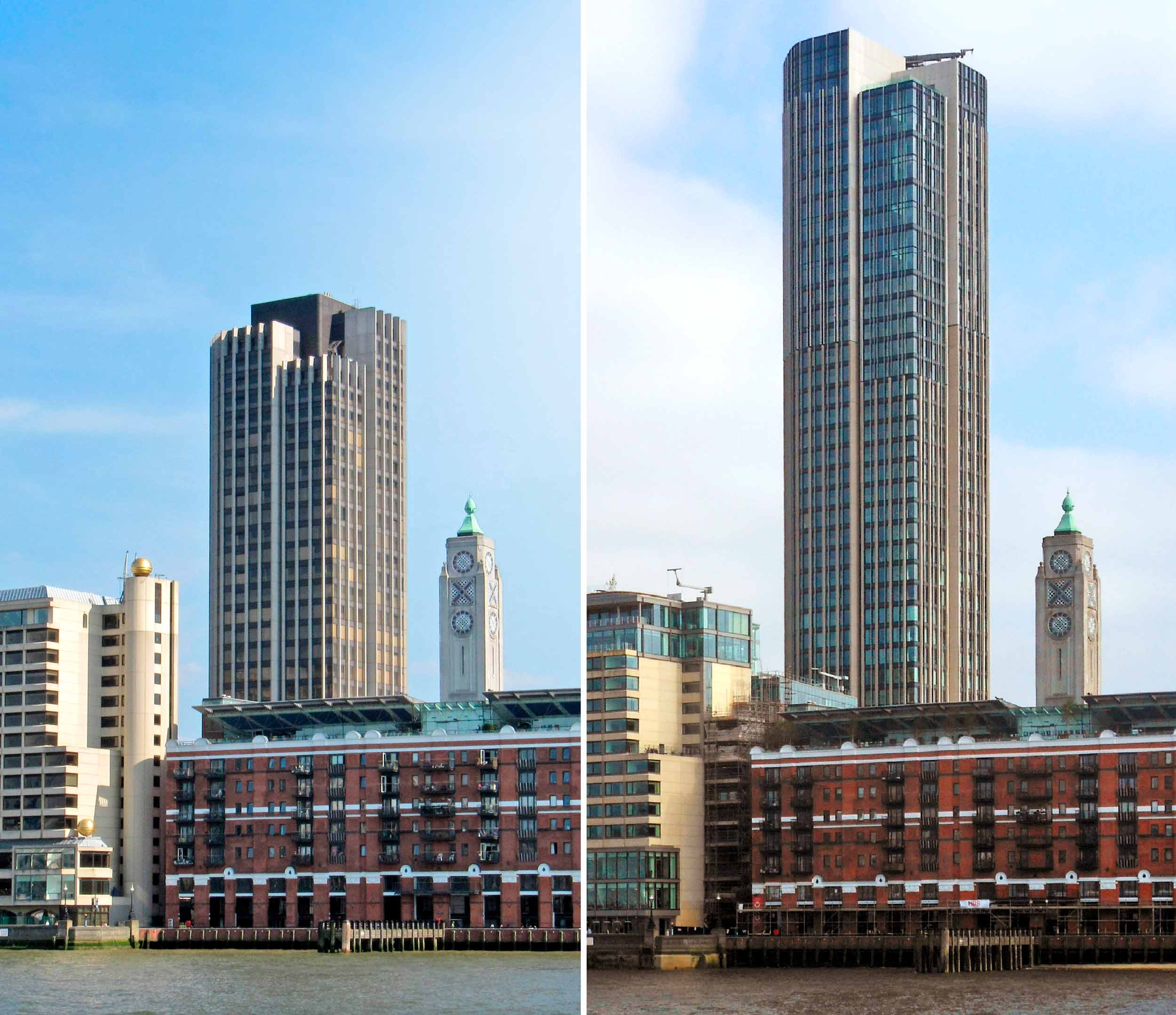
The design director of the consultant - AKT II - explained the economics clearly favoured the expansion and conversion into a office-and-residential property. It would’ve taken three years to get the planning permission to knock down and replace the original structure - permission which wasn’t guaranteed. Generally, developers are also wary of wracking up loan interest during a long and costly demolition process, along with volatile new material costs.
Originally built in 1972, the building’s drawings were available to be bought from the original architect, Arup. This allowed the new engineering team to evaluate what would be feasible for a concept from the get-go and save site investigations for later in the development process.
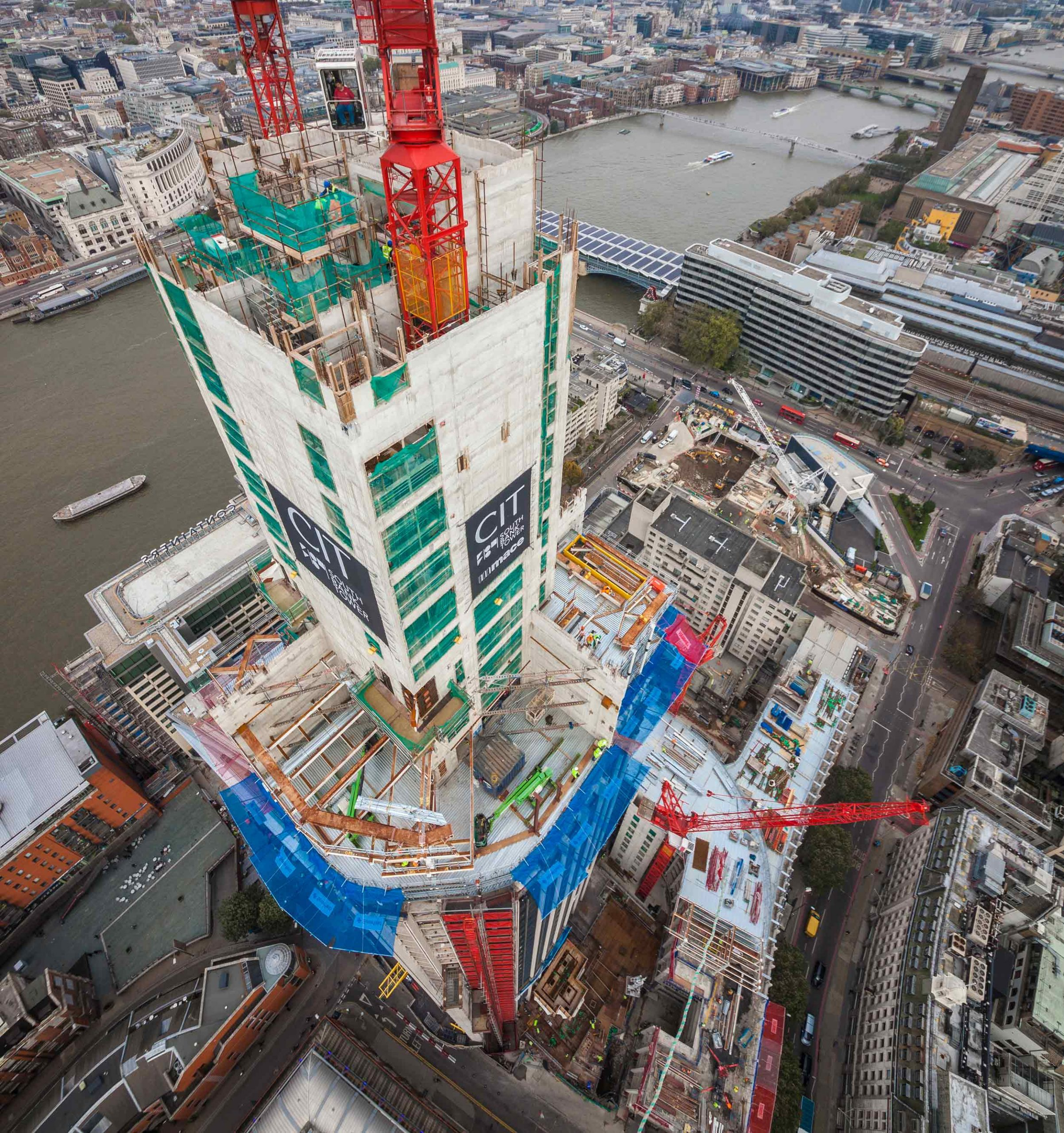
The deciding factor in this building’s vertical extendability was the soil on which it stood. The tower was founded on clay that had 45 years to consolidate and stiffen as pore pressures increased under the weight of the structure. This meant the load on the 79 under-reamed piles could be increased by up to 25% (5,000 kN to 7,000 kN per pile). This meant the extension required no additional piles.
However, they couldn’t start stacking on extra floors just yet. To extend on top of the building’s raft foundation, they had to take some weight off to balance the new loading effects. They dug a new basement to about 10m above the Waterloo & City subway line and quickly poured a slab over that.
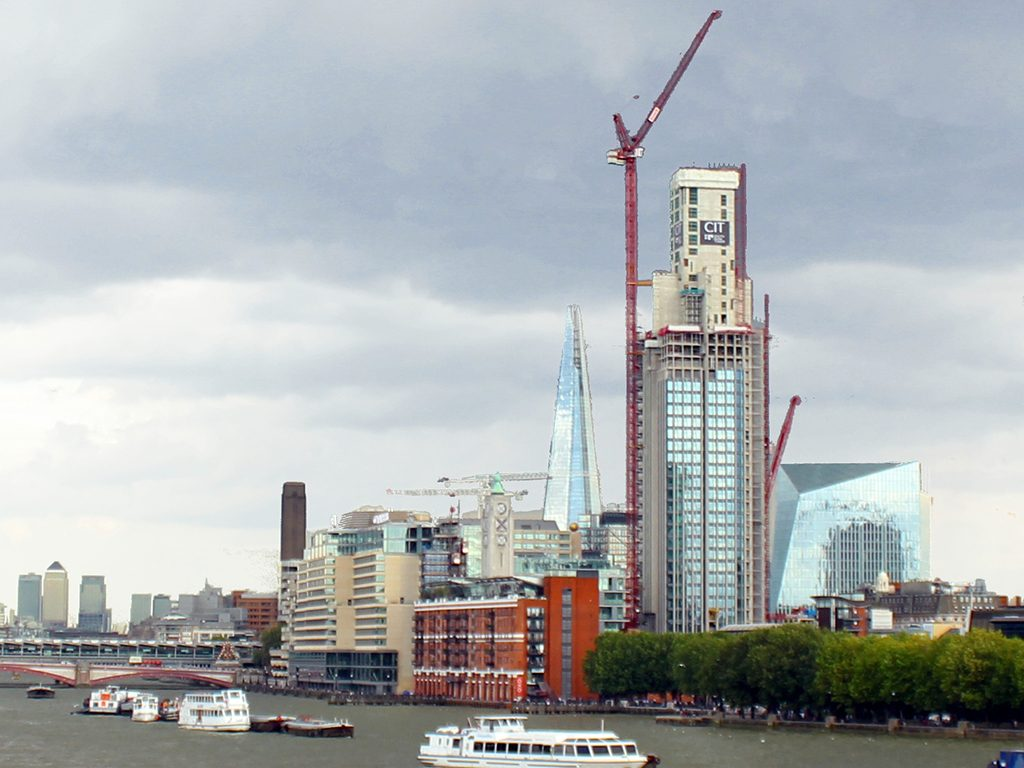
The building’s brutalist design also made it a good candidate for an extension - for example, exposed precast columns that didn’t reduce in size the higher up the building they extended. Finally, cores designed for the big, heavy lifts of the 70s meant that modernizing elevators and moving them to the edges of the building could unlock residual structural capacity. In fact, as the design teams got used to the building, they realized they could modify it more than they originally thought possible. By the end of the project, they’d removed almost 30% of the original core’s concrete.
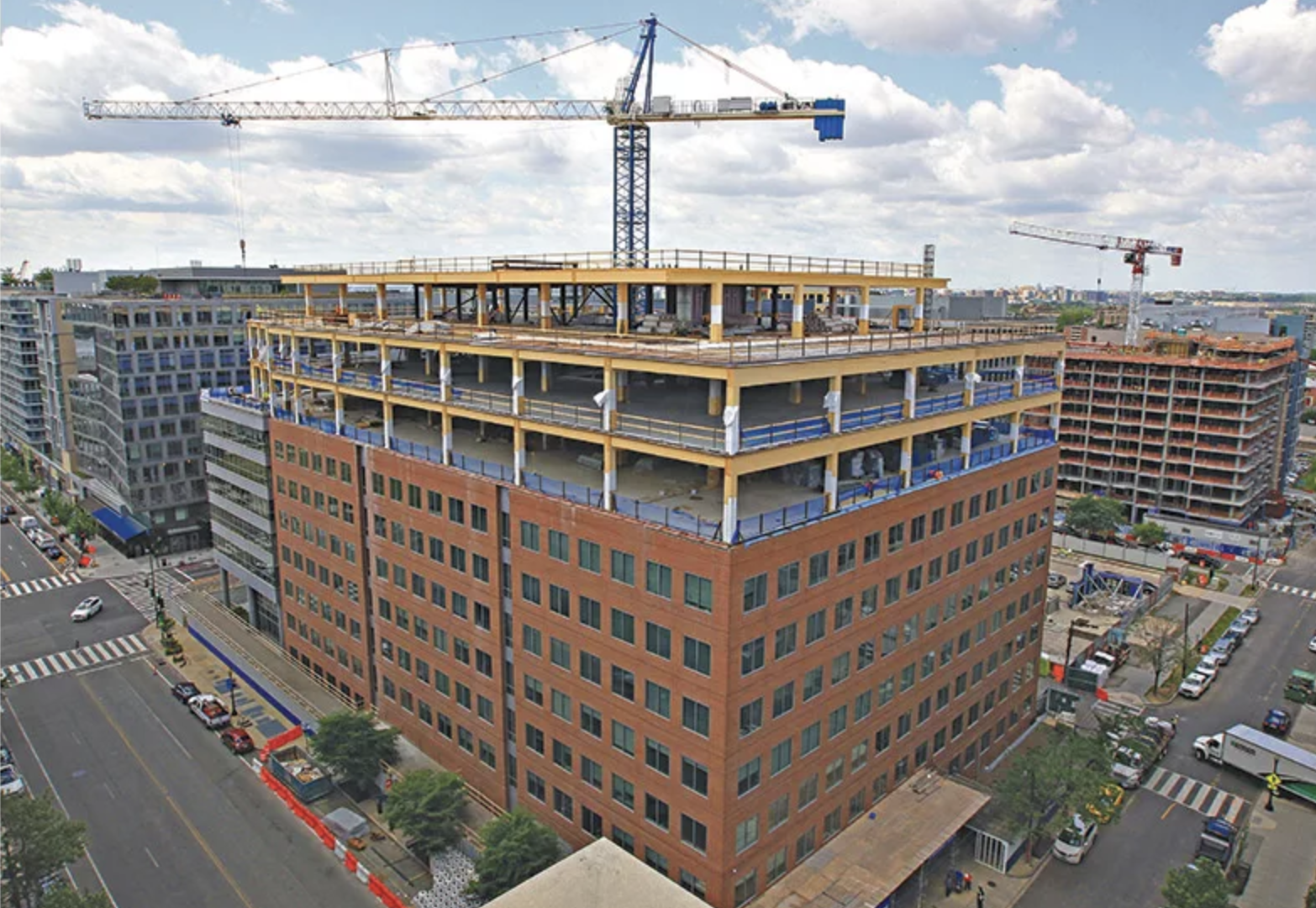
Capitalizing on unoptimized material placement won’t work with most buildings post-1990 - computer-optimized designs mean there’s less unintended extra capacity to work with. Fortunately, the surge in popularity of light-weight mass timber and engineered wood products can be leveraged to unlock vertical extensions with less added reinforcement. For example, the two storeys added to this office building in Washington, DC represent the first high-rise overbuild timber structure in North America. This project used steel to reinforce the core and is primarily composed of concrete-topped CLT floor cassettes.
The Business Case - EU vs. The World
While researching examples of aufstockungen, a common theme came to light. Vertical extensions have been common in Europe for centuries, but are mostly absent elsewhere in the world. Why is there a business case for vertical extensions in Europe but not, for example, in North America?
Zoning
At some point, everything built-environment comes down to regulation - specifically, zoning.
Europe’s existing residential housing stock is primarily made up of densely packed mid-rise apartment blocks - a far cry from North America’s sprawl in the suburbs and low-rise zoning in mid-sized cities. For instance, Vancouver is mostly made up of single-family zoning protected by heavily permitted development rights. If you were suddenly allowed to build up to six floors, the cost and technical complexity of adding one more floor to an existing light timber-frame Vancouver Special would be far greater than simply building a new six-storey multiplex (which would also generate more rental revenue).
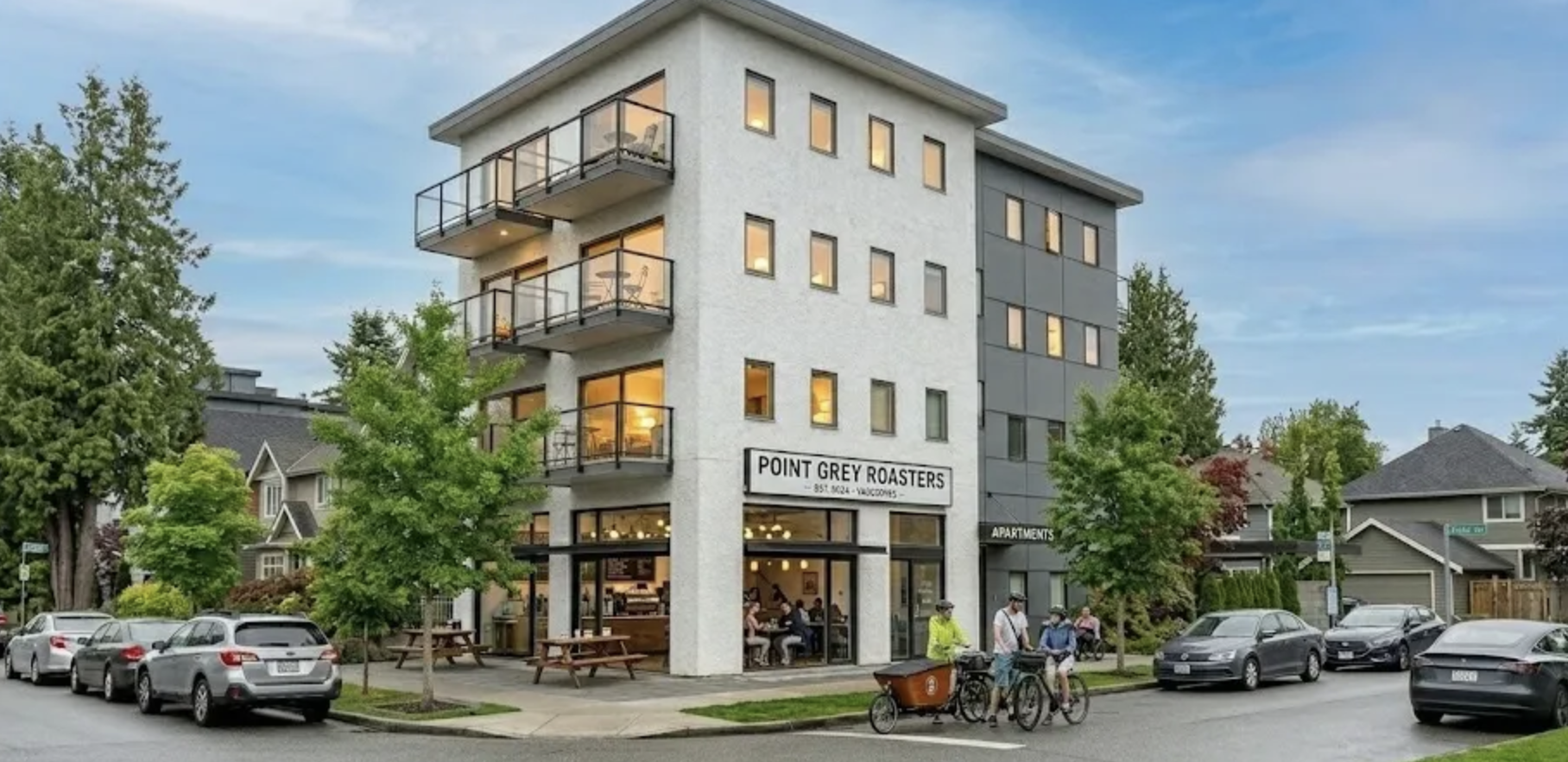 Credit: Bryn Davidson’s visualizations of mid-rises in Vancouver’s “residential” neighbourhoods
Zooming back out to Europe, there are many areas with existing mid-rise housing stock already at local zoning height limits. Here, the economics of demolishing and constructing an entirely new building that’d be the exact same height as the old one wouldn’t make financial sense, especially considering the operating revenue lost in the time taken to build new. Instead, developers would be more likely to leverage favourable zoning policies where present, such as by-right vertical extensions, or density bonuses for low-carbon retrofits (both of which we’ll touch on later).
How does this zoning-for-extension play out in practice? The UK codified its intent to accelerate “PDRs” - permitted development rights - for upward extensions in England through its Town and Country Planning Order in 2020. When introduced, the policy proudly stated it would unlock 3,000-4,000 homes per year. In practice, these “rights” were still subject to prior approval by the local planning authority with regards to design, daylight, and heritage impacts. In the first 18 months after introduction, DLUHC / MHCLG – Planning Application Statistics approximated national total applications at 400-500, with 200-250 applications granted, equaling just 1,000 homes delivered.
Another aufstockung policy mismatch is that under current UK tax rules, VAT on the construction of new dwellings is zero-rated, while structural alterations to existing residences are taxed at 5–20%.
Ownership and Tenant Protections
Turing back to our comparison of continents, Europe’s vertical extension trend is assisted by their property ownership structures.
In Switzerland, 40-50% of rental housing is owned by private individuals, while institutional investors own 20-25%, and housing cooperatives / government own the rest. This is quite the opposite in North America, where real estate investment firms and big development companies own large plots of land. These corporations typically evaluate projects based on their ability to maximize site value, through the cycle of holding land for appreciation, demolishing existing units, and erecting much larger buildings.
This contrast in ownership shows why vertical extensions are more popular for smaller landlords - for a fraction of the capital (equity + financing) needed to build an entirely new building, they can add one or two floors to their building and increase their rental income.
The final European structure tipping the scales in favour of vertical extensions for smaller landlords are municipalities’ strict demolition and tenant protection laws. In the case of Basel, Bern, and Geneva, there are twice as many buildings extended vs. replaced each year. Geneva and Basel are city states, giving them more leeway to create and enact policy like their LDTR (Law on Demolition, Transformation, and Renovation of Residential Buildings), which limits rent increases after demolition or renovation, and allows exceptions to maximum height limits for rooftop additions (though still limited by conditions related to character, daylighting, and skyline maintenance).
A small landlord wouldn’t have the capital nor the drive to bankroll lawyers, evict tenants, and run 2-4 years with zero revenue. Compare this to the option of leveraging the existing land value while maintaining most of their existing tenants across a shorter construction cycle.
Whole Lifecycle Carbon
A big reason vertical extensions are coming into the wider developer discourse is because of the EU’s increasingly-strict requirements for reduced whole lifecycle carbon (embodied/Scope 3 and operational/Scope 1-2).
For example, Basel-Stadt enacted carbon pricing for housing construction in 2023. Fast forward to November 2024, and Swiss feds stated cantons must set limits for embodied carbon in buildings (ex. 12 kg CO2-eq/m^2 for multi-family homes). Coupling these limits with steering levies would make high-emissions builds more expensive and discourage demolition projects.
These updated guidelines say buildings must minimize emissions across their entire lifecycle, and that negative emissions or offsetting can’t be counted in compliance. This strict carbon accounting meaningfully shapes construction strategies - for example, solar power can only be counted towards the project’s CO2 balance if it’s consumed on-site, and can’t be counted if it’s sold on the carbon market as a renewable energy certificate. On the flip side, reused building components can be credited towards lowering CO2e emissions.
Policy levers like these can help integrate circular economy principals into local authority plans, encouraging developers to think beyond a building’s demolition.
For instance, instead of designing a building for the most extreme future use-case (a practice which increases structural capacity and embodied carbon), developers could work with engineers to generate intervention plans for potential future adaptations. How could an office tower be converted into a residential complex, or strength added in key columns to unlock vertical extendability. This is a small amount of upfront work relative to the potential rewards long-term (and follows the principals of the time-value of money).
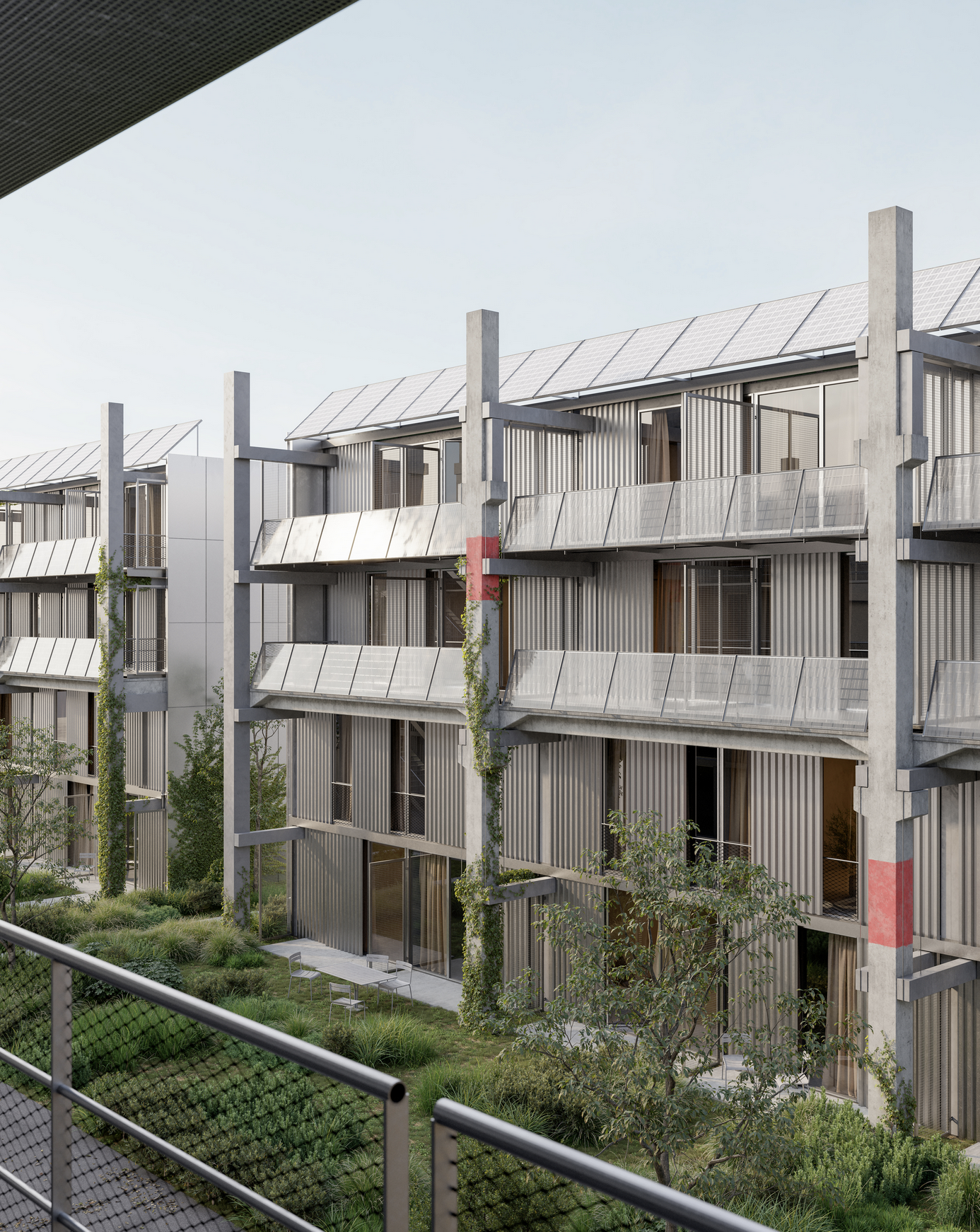 Parabase, a circular architecture studio in Basel, reused prefab concrete elements in this 2023 housing development
Today, there is real progress being made on these types of policy. In January 2026, the EU unveiled some big steps in this direction with their Building Renovation Passports (BRP) scheme.
The BRP programme’s aim is to provide building owners and professionals with structured digital tools to plan staged renovations in line with EU energy and climate objectives, such as low-energy retrofits and vertical extensions. This builds upon the information held in the EU’s current Energy Performance Certifications (EPCs) by providing digital data about a building’s renovation journey to date and offering building owners tailored recommendations for next renovation steps.
This BRP scheme is directly translatable to a North American context. After the City of Vancouver implements policy allowing by-right 6-storey mid-rises, the makeup of housing will start to look similar to Europe - blocks of mid-rise apartments owned by small landlords with strict tenant eviction policies. To proactively create the conditions for a boom in vertical extensions 20+ years in the future, the City should tie reduced whole lifecycle carbon emissions to density bonuses, and BRPs should be required for every new building. This is minimal added upfront effort with clear future financial incentives - for instance, slightly stronger columns could be installed or stronger foundations poured to make every mid-rise vertically extendable by 1-2 stories.
BIM Sidebar This type of lifetime building passport is a clear signal that smaller builders should integrate BIM into their workflows. Builders in Asia have been doing this for a decade and are already reaping the benefits of fewer conflicts and enhanced construction monitoring. The lifecycle connection can be made by updating BIM models throughout construction with as-built info, including design changes, material testing results, and metered energy usage. This shifts BIM thinking into “digital twin” thinking, which will make future vertical extensions significantly easier to evaluate from a financial and technical perspective.
Counting Carbon
In the decade since the adoption of the Paris Climate Agreement, there are many decarbonization technologies whose actual impact on lowering net GHG emissions is fiercely debated (ex. carbon capture). It’s important to consider whether aufstockungen have the ability to meaningfully lower lifecycle carbon emissions.
A 2025 Swiss study on renovation vs. replacement strategies (for <6 storey blocks of flats across different construction time periods) studied the variation in GHG emissions across multiple scenarios. Regardless of the building type, each one showed that achieving a 95% reduction in heating energy required a higher total GWP compared to other archetypes - for example, simply replacing the natural gas heating system with a heat pump.
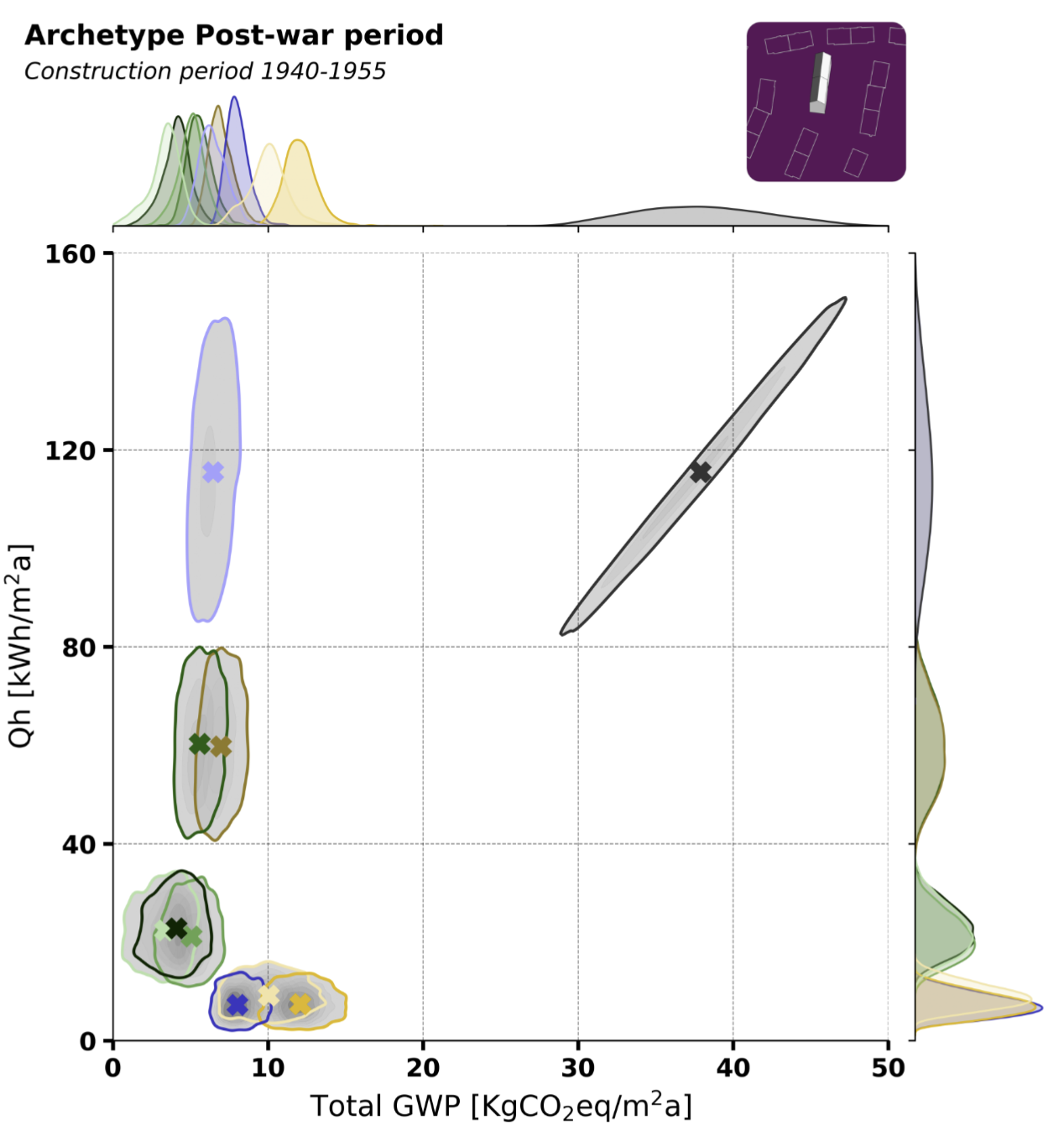 | 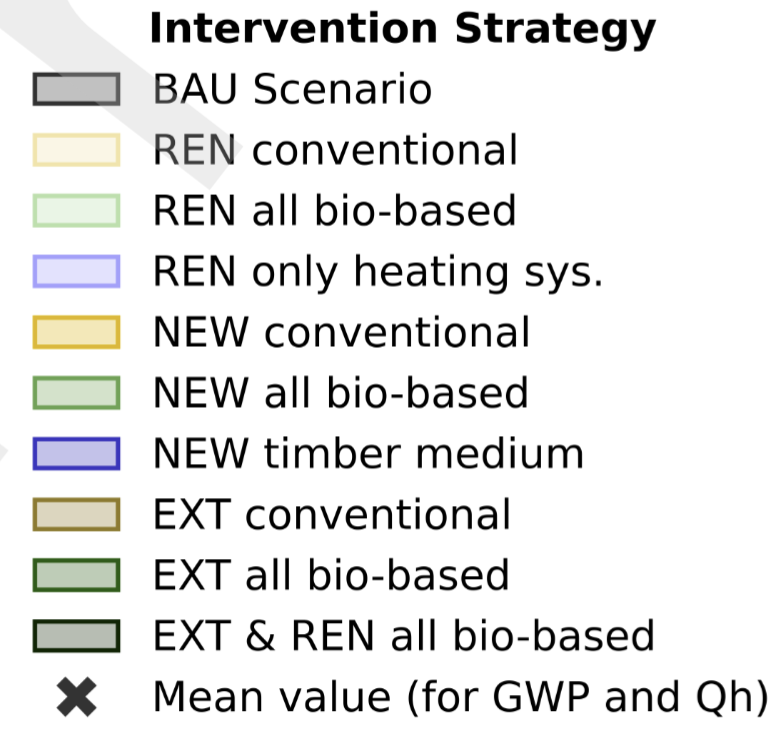 |
This chart shows that the lowest GWP strategies are, in order:
- REN (renovation) all bio-based
- EXT (extension) & REN all bio-based
- NEW all bio-based.
However, the results show wide error bars and means quite close together.
Note that bio-based refers to straw insulation in renovations, self-supporting timber structures with low fractions of CLT in new builds or extensions, and rammed earth non-load-bearing walls.
There are other interesting tidbits sprinkled throughout this study. Current timber replacement constructions still have 1.2 to 1.9 times the total GWP of the vertical extension strategies. Additionally, compared to heating system and insulation choices, different densification strategies (new vs. extend) had minor impacts on total GWP.
- One possible reason is that for conventional replacement construction components, designs that optimize material efficiency were used. Realistically, for example, 18 cm concrete walls might be specified but standardized 25 cm or double layered walls are often built.
The relationship between “reduce, reuse, recycle,” and construction is best summed up by the popular phrase, “the greenest building is one that is already built”. This aphorism was coined by Carl Elefante, who went on to note that modifying building materials to reduce operational carbon - techniques popularized by LEED and Passivhaus like triple glazing and thicker insulation - can look very different when viewed from a lifecycle perspective. Consider the following: when local grids are decarbonized and buildings are solely powered using renewable electricity, operational GHGs are zero. Heat pump retrofits can’t be the end of the carbon accounting conversation.
Traditional materials that require less processing during manufacturing, have long service lives, and are favourably repairable, are less carbon intensive over their lifetime than heavily processed “maintenance free” materials that end up in the landfill within 2-3 decades. This points to the importance of considering reuse over replacement. Of course, buildings will be replaced at some point - the key is to spread out the embodied carbon intensity of a building over a longer period of time, a smoothing effect critically needed over the next 100 hundred years to reduce global GHG emissions and heating.
Of course, our cities are growing, and one doesn’t have to look far to find hundreds of articles on the extreme housing cost rises that have accompanied city’s refusal to proactively zone and build new housing. In fact, affordability is a function of having older buildings in our cities that have already been paid for. The construction cost and land purchase have already been amortized, and structures like vacancy chains can take effect to lower rents.
 Europe excels at reusing the old while integrating the new.
Cities must strike a balance between new developments and old retrofits - the very word “preservation” has a modern-era bias to it. Buildings are usually thought of as artifacts, while in reality they have to work for a new generation of users during a new era with different demands. Buildings must be allow them to change, not be frozen in amber. By baking flexibility into the built environment, GHG reductions will follow.
Metrics linking carbon emissions to city expansion can be units like kgCO2e / m^2 - the marginal embodied carbon cost of delivering the next unit of space. Policy makers shouldn’t just say “pick the lowest embodied carbon development”, since that might incentivize retrofits insufficient housing, office space, hotel space, etc. is created for the city’s growth/affordability plans.
Additionally, it’s important to remember the knock-on effects that a simple LCA can’t capture - artificially capping dense development means fewer units get built, rent rises, and housing shifts away from city centers (sprawl). Paradoxically, blocking the addition of floors in a building - whether new or extended - will likely increase system-wide emissions. Cities must proactively decide how to maximize units in the most carbon-efficient locations while minimizing embodied carbon per delivered unit.